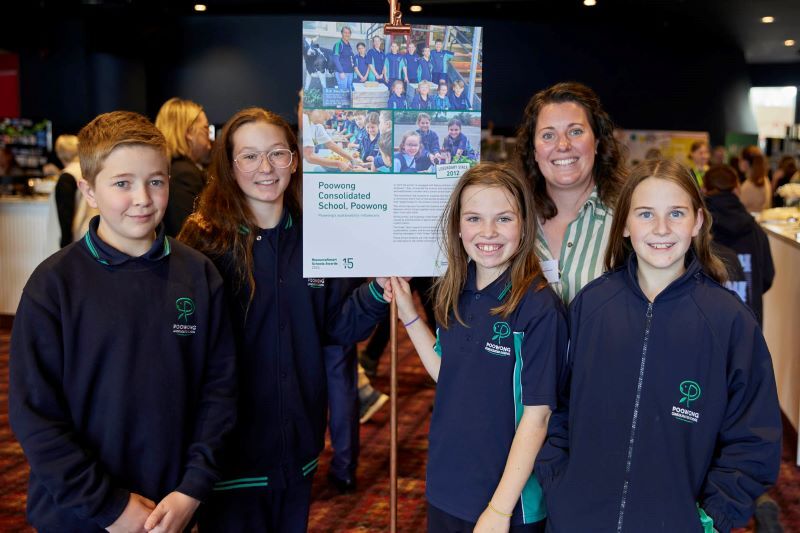
Students from Poowong Consolidated Primary School, with Science Teacher and Sustainability Lead Lauren Dobie, at the ResourceSmart School Awards 2024
Poowong Consolidated Primary School
Joined ResourceSmart Schools: 2022
Location: Poowong (Gippsland)
Students: 115 prep to grade 6
Money saved*: $29,328
Poowong Consolidated Primary School became a ResourceSmart School at the beginning of 2023, and Science Teacher and Sustainability Lead Lauren Dobie can’t believe she didn’t join sooner. 'It's a really good program. I love the way it's structured,' she says. Since joining the program, this small school of just 115 students has saved $29,328*.
Lauren says that because she can pick and choose which activities are relevant to her science teaching, she makes the program and its resources work for her, without the pressure of completing modules. 'Instead of rushing through something like the worm farms, it spreads over multiple parts of the waste module. The learning is deeper, across year levels and Green Team,' she says.
Poowong is just starting on its sustainability journey – it’s in what Lauren calls their 'eye-opening stage'. Since starting to use the program in her classroom she has noticed the children questioning more, and paying more attention to things like waste, nature and the school grounds. 'We started working on biodiversity and waste partly because they were easy connections for students to make at this school with our space and resources,' says Lauren.
Bringing science to life has always been what Lauren loves about teaching, and she is using ResourceSmart Schools to make sustainability and science an everyday part of school life, too.
'Currently the grade 4s are doing a landfill experiment. We are talking about how a lettuce head can take 25 to 30 years to decompose in landfill, and why that is, compared to composting a head of lettuce. The students did not believe it and were surprised when their results were matching with the information we found. That has been blowing their minds,' says Lauren.
Getting students outdoors increases their wellbeing
Lauren says the children love being outside as part of the ResourceSmart Schools program and get a great sense of pride from gardening and improving the school grounds themselves. 'The students are really into Garden Club and seeing their sustainability projects come to life,' she exclaims.
'I am proud of us getting compost bins happening – about 100 kilos of our food waste has been put in compost instead of the bins, and it's already started to decompose down, which we love to see.'
She has seen students take particular interest in the biodiversity module with the creation of a Garden Club. 'Garden Club is very passionate. Kids enjoy it. They anticipate it, they love it. We're doing so much out there all the time.'
Lauren and her students have planted native herbs, which they then cook with. 'We’ve been taking more care of the gardens. It's been mulched and we've planted green manure crops to build some soil health. Our veggie gardens are thriving – we've got potatoes that are about to be pulled out to do a hot lunch.'
'Garden Club is very passionate. Kids enjoy it. They anticipate it, they love it. We're doing so much out there all the time.'
The ResourceSmart Schools facilitator can help tailor the program
[insert image]
Food grown in the school garden and donated from the community for the Harvest Festival
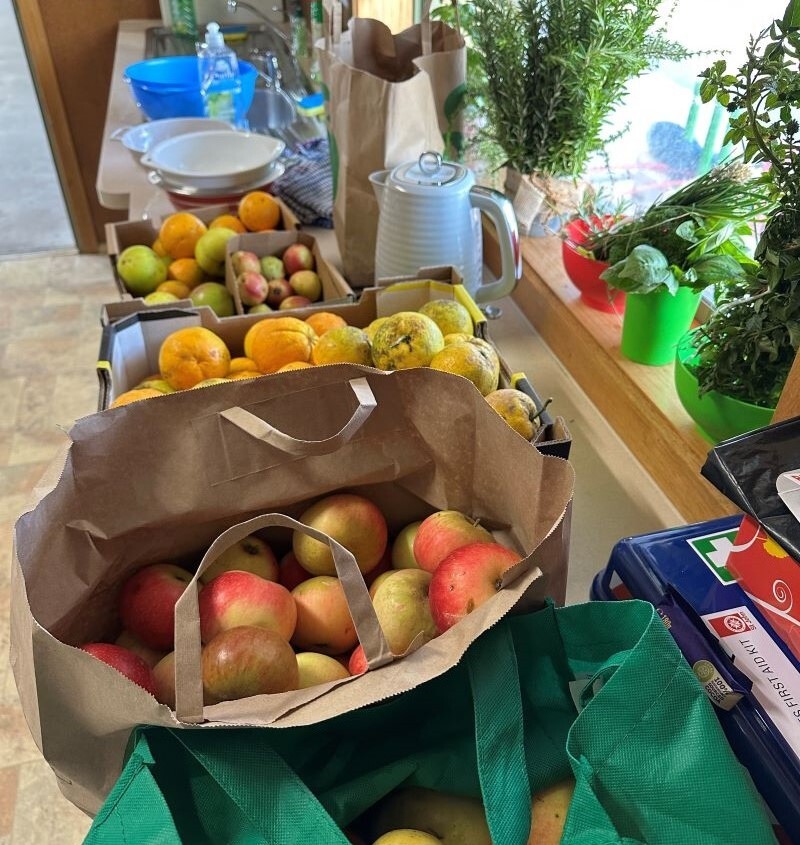
Community and parent support for the ResourceSmart Schools program creates support
Note
* Resource and monetary savings are calculated by the ResourceSmart Schools Online web application and reflects billing information entered by school users.
Savings are calculated as an estimate and are a comparison of baseline usage and expenditure for a period of 12 to 24 months prior to commencement of the program.
Estimated savings are based on per student usage, expenditure and total student population. Savings reported in this story were correct at the time of publishing.
Page last updated: 14/08/24