Overview
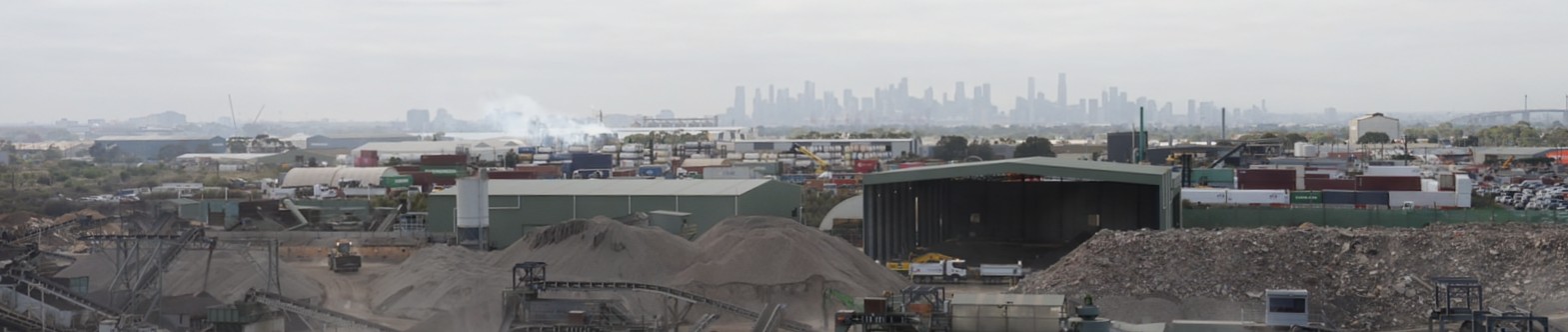
The Air Quality Improvement Precincts (AQIP) Grant program supports targeted initiatives that reduce air pollution and improve public health outcomes. The program focuses on priority areas across Metropolitan Melbourne’s Outer West and Inner West. These areas have been identified as two of Victoria's key air pollution hot spots.
The program is an initiative under Clean Air for all Victorians: Victoria's Air Quality Strategy. The Strategy includes $2.84 million to establish two air quality precincts to:
- implement actions to reduce localised air pollution and
- to support regulatory implementation of recent environment protection reforms.
The Government offered two rounds of grants for businesses in the precincts to reduce their PM10 (dust) and PM2.5 (smoke) particulate matter air pollution.
By funding these initiatives AQIP enables innovative, scalable solutions that respond to community needs, delivering measurable environmental benefits.
Round One grants 2024-2025
Project summary
Purchase and installation of a scrubber system to reduce and capture smoke and dust from operations at the Metal Separation and Trading Company e-waste facility
Funding - $31 000
Project summary
Additional dust control measures at an e-waste facility, including a fog cannon (a misting system using water to suppress dust), sealing of infeeds/outfeeds, additional suction points, and additional air filters.
Monitoring system to notify of high dust levels prompting activation of the fog cannon above.
Funding - $50 000
Project summary
A Better Environment Plan (BEP) is a new instrument under the Environment Protection Act 2017. It is a voluntary agreement between Environment Protection Authority Victoria (EPA) and duty holders and encourages innovative solutions to environmental issues or agreeing to ways in which duty holders can exceed their environmental obligations. The funding contributes to the below select initial components of a Better Environment Plan:
- Develop a shared incident and dust monitoring response system.
- Develop a Vegetation Planting and Landscaping Plan.
- Develop, deliver and evaluate training for BEP participants.
- Develop an auditing plan and undertake routine audits.
Gypsum & Fertilizer Pty Ltd is the lead organisation responsible for administering this funding on behalf of a four-partner collaboration that comprises the BEP. The three other participants are City Circle Recycling Pty Ltd, Resource Co Pty Ltd and Delta Recycling Pty Ltd.
Funding - $145 000
Project summary
Purchase and installation of two Contactless Sheet Cleaning Systems to remove dust from two internal production lines before it can be emitted.
Funding - $100 000
Round Two grants 2026-2027
Project summary
This project will seal three high-use crushed rock car parks near 3 sports reserves to reduce PM2.5 and PM10 emissions, directly addressing a known dust issue in sensitive community areas.
The project will reconstruct the existing car parks to include improved drainage, kerb and channel installation, and a durable two-coat seal surface. These upgrades will stabilise the surface and significantly reduce dust emissions. The project will deliver a practical and long-term solution that enhances community infrastructure while directly reducing particulate pollution in these high-use public spaces.
Funding - $384,147
Project summary
This project will establish native green hedges along school boundaries to act as a natural barrier against dust. The hedges will also enhance biodiversity, provide habitat for native species, and contribute to a more visually appealing and shaded environment for students and the broader community.
To further reduce dust exposure in high-risk areas, low-flow misting systems will be installed in locations prone to dust generation. These systems operate by suppress airborne particles by lightly dampening surfaces. Together, the green hedging and misting interventions provide a complementary, and practical approach to dust management.
Funding - $12,150
Project summary
This project builds on work funded under AQIP Round One, delivering Victoria’s first EPA Better Environment Plan (BEP). The project has already progressed in managing dust and improving local air quality through targeted training to build organisational capability, as well as extensive research and development into innovative and practical dust management solutions.
Alongside this, community engagement has been undertaken to understand local concerns. Operational measures such as street sweeping have been implemented to actively reduce dust levels in affected areas.
The proposed project represents the next step in this ongoing program, leveraging the knowledge, partnerships, and momentum already established. By building on these prior investments.
Funding - $120,000
Project summary
This project will deploy Fresh Air Innovators educational packages to schools, community groups, and non-government organisations across the AQIP target regions.
The education component will build awareness and understanding of air pollution sources, impacts, and mitigation strategies . By embedding this learning within school and community settings, the program supports longer-term behaviour change and empowers participants to take an active role in improving their local air quality.
Providing calibrated air quality monitors strengthens educational outcomes by giving students access to reliable, real-time data. This enables schools and community groups to better understand local pollution patterns, identify potential sources, and respond appropriately during pollution events. With this information, participants can make informed decisions about outdoor activities and exposure and helping to protect their health while developing a stronger connection to environmental monitoring.
Funding - $250,000
Project summary
This project will enhance localised air quality monitoring and assessment across Victoria by supporting local governments to establish sensor networks through strong community collaboration. Inspired by the NSW OPENAIR model, the initiative will build the capability of councils to implement consistent, reliable, and locally relevant monitoring systems.
To support this, the project will develop Best Practice Guidance materials that outline standardised approaches to sensor selection, data management, and community engagement. A shared collaborative platform will also be established to facilitate data sharing, knowledge exchange, and coordination between participating councils and community partners. This will allow for actively identifying local pollution hotspots, enabling greater awareness of air quality.
Funding - $280,000
Project summary
This project aims to create Nature-based solutions (NBS) to significantly reduce pollution concentrations at this identified hotspot, with a target reduction of over 50%. State-of-the-art monitoring and modelling will guide the design of NBS interventions.
Reduced concentrations will be demonstrated using a network of sensors to measure the impact on PM2.5 and PM10. Community groups will be engaged through citizen science workshops to monitor pollution and raise awareness of the role NBS can play in sustainable air pollution control.
Funding - $265,661
Contact
For AQIP queries, please email: aqip@deeca.vic.gov.au